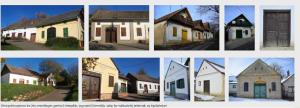
The areas of the village under local protection are the historically developed cellar rows and the public green spaces between them. Viticulture was established early in the border of the settlement and, compared to other agricultural cultures, showed some progress even during the subjugation. The XIX The replacement of the vines that were destroyed during the great phylloxera epidemic at the end of the century took place in barely a decade and a half. The buildings and cellars necessary for grape processing are mostly located in the interior of the village, with their design following the topography. The buildings were organized into streets with bush-like plantings, built on a small plot of land, where the grapes were transported for processing. The cellar houses were built close to the public area, sometimes with a front garden, but this was more for better access due to the topography. In many cases, they are located on floating plots, their deep cellars extend below public land or other plots, without a significant adjoining vineyard area. The cellar houses with larger farmland were built on the outskirts, on the outskirts. These economic buildings were concentrated in three areas of the settlement: on the west side, the Szyzky cellars, on the east side, the Szederkény cellars on the hill of Pincesor utca, and on the south, the cellars shared by Táncsics Mihály and Petőfi Sándor utca. The architectural design of the houses built in the area was largely determined by the style of the settled German population and economic expediency. The installation, mass formation, and detailing of the buildings are varied. In cases with ridges parallel to the road and the topography, the facade is raised with a knee wall at the front, in some cases a continuous porch with pillars connected by an arch in pairs, or a ridge perpendicular to the road, sometimes with a wooden cantilevered balcony on the roof. The adaptation to the terrain is natural, the deep cellars open from the buildings. Solid wooden doors, tall, four-eyed wooden shuttered windows in the work space, small windows for ventilation of the upper space, more solid facade decoration and tiled coverings are characteristic of the buildings.